
Rust wiped on September 3 and the devblog that landed with it is called Breach and Clear. On the surface it reads like a monument patch: new blockers in front of red card puzzle rooms, HQM nodes hidden in the jungle, a drone marketplace that now depends on the power plant staying lit. Scroll further and it turns into something else. This is the heaviest server performance patch Facepunch has shipped this year, and one balance change quietly rewrites how upkeep works for anyone who plays in a group.
Here is what actually matters if you run a Rust server rather than just play on one. Start with the change everyone sees on wipe day: every monument with a red keycard puzzle room now has a physical blocker in front of it, it takes serious damage to break, and once destroyed it never respawns for that wipe. Facepunch calls it a speed bump for the players who sprint to red rooms in the first thirty minutes, not a progression nerf.
The tool cupboard now taxes big groups
This is the change your players will argue about in Discord. Tool cupboards apply an extra upkeep tax based on how many people are attached to the base. Facepunch counts anyone authed on the TC, anyone deauthed from it in the last 24 hours, anyone authed on a code lock inside the base including guest codes, and anyone deauthed from a code lock in the last 24 hours.
The tiers are simple:
- First 4 players: no tax
- Next 6 players: 2% extra upkeep each
- Everyone after that: 4% extra upkeep each
A six person base pays 4% more. A twelve person base pays 20% more. The tax caps at 300%, and hovering the upkeep cost in an open TC shows the current rate.
The line that matters for server owners sits at the bottom of that section: the whole behaviour is exposed as a set of ConVars in the Decay class, and you can tune it or disable it entirely. If you run a modded 2x with large clans, look at those before your zergs start losing bases on a Tuesday rather than after. Our Rust upkeep calculator still gives you the base cost per building block, and the group tax now stacks on top of that number.
Physics got roughly twice as fast, and the server gets most of it
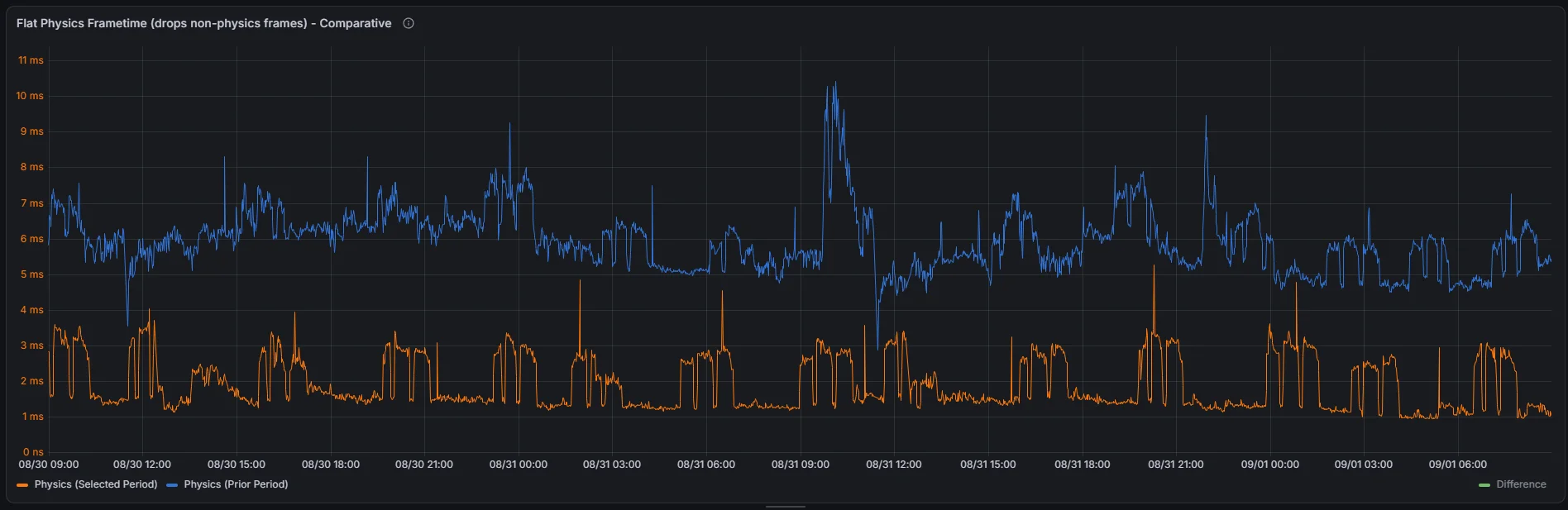
Facepunch customised PhysX again this month, adding a new broadphase mode built on a BVH structure and applying the same structure to physics queries. The old implementation scaled with the number of colliders in the world, and that number only ever grows across a wipe. The new one scales with the number of changes being made, which tracks active players instead.
The graph above is Facepunch's own comparison of the weekend before the change and the weekend after, on one of their servers. Physics frametime falls from roughly 5 to 7 ms down to 1 to 3 ms. That is a doubling on that machine. Your numbers depend on population and how built up the map is, but the direction is not ambiguous, and late wipe is exactly when Rust servers usually start to fall over.
Three more performance items ship in the same patch. Around 300 entity types, things like signs, mushrooms and driftwood, moved to a close network range, which cuts network overhead for client and server. Memory usage dropped by more than half a gigabyte in early testing. Vehicles are now pooled instead of destroyed and rebuilt every time they leave your network range, which removes the 20 to 30 ms stutters you get while driving.
If your server was already struggling before this patch, the fixes in our Rust server lag guide still apply. Breach and Clear raises the ceiling, it does not rescue an undersized box.
Oil rig loot finally survives the nightly restart
Most Rust servers restart daily for stability, and until this patch a restart in the middle of a big event simply deleted it. If you were holding oil rig when the server went down, the loot crates and the hackable crate you had been sitting on for twelve minutes were gone when you rejoined.
Server event state is now saved and reloaded properly for the oil rigs, cargo ship, patrol helicopter, Bradley and the new satellite crash sites. This is the change most likely to stop a support ticket landing in your Discord, and it costs you nothing to get. It is already in the build.
The new navmesh is still opt-in
The rewritten navmesh has been in the game for a few patches behind the -useNewNavmesh command line parameter, disabled by default. This month Facepunch enabled it on some of their own servers to watch it, and they intend to make it the default either as a hotfix or in next month's patch.
Turning it on now writes the navmesh to disk so restarts can boot faster, and moves NPC navigation off the main thread and onto background threads. The player facing side is smaller and stranger: animals may occasionally wander into bases and monuments. Test it somewhere that is not your main server, because the default is coming anyway.
Balance changes your players will notice on day one

The attack helicopter is counterable again. Cockpit armour now falls off in stages as it takes damage, exposing the pilot and gunner, with the left panel going at 680 hp, the right at 595 and the front at 510. Armoured HABs get the same conditional armour across four panels, from 2250 hp down to 1500.
The rest, briefly. Heavy plate helmets now suppress noise but cost more to craft, while heavy plate jackets and pants make audible noise when you move. Radwater in sprinklers seeps through more armour types, and hazmats remain the counter. SAM sites got much better at killing drones. Modular cars picked up a handbrake on CTRL plus reworked steering and suspension, with high latency handling called out specifically. The drone marketplace only accepts purchases once the power plant has four or more fuses running.
What to do on your server this month
Three things. Decide whether you want the group upkeep tax active and set the Decay ConVars before your biggest clan complains rather than after. Test -useNewNavmesh somewhere that is not your main server. And if you had a hardware or RAM change planned, measure first this month, because the physics and memory work may have already bought you the headroom you were about to pay for.
October's force wipe is the first Thursday of the month, and our Rust wipe schedule counts it down. If you want a server on the new build without doing the setup yourself, our Rust server hosting runs on Ryzen 9 hardware with one-click Oxide installs.