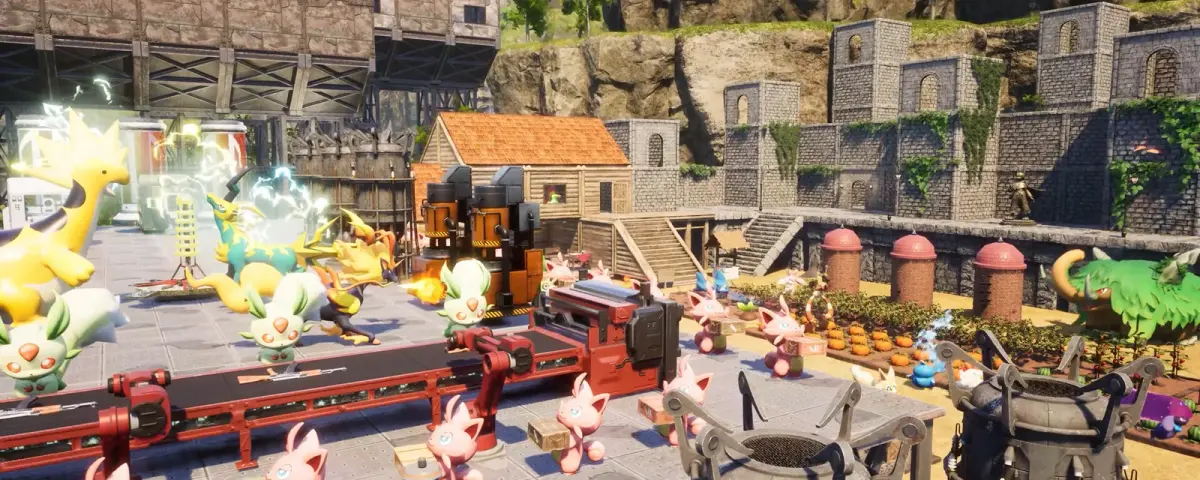
Two Pals, a Cake, and a Breeding Farm. That is the whole interface Palworld gives you, and it hides one of the most misunderstood systems in the game. The child is not random. It is not "mix the two elements" either. Every Pal carries a hidden number, and the game does arithmetic on it.
Once you can see that number, breeding stops being a slot machine and becomes a supply chain. Here is how it actually resolves in Palworld 1.0, which pairs ignore the math entirely, and which Pals no pair will ever produce.
The formula behind every egg
Every Pal has a hidden breeding power. It has nothing to do with rarity, level, or combat stats. Lamball sits at 3050. Arsox sits at 2320. Jetragon, the fastest mount in the game, sits at 70.
Put two Pals in the Breeding Farm and the game averages their powers, rounding up:
target = floor((powerA + powerB + 1) / 2)
Then it picks the Pal whose own power lands closest to that target. Ties break toward the higher power, then toward the Pal's internal roster order, then toward the base form over its variant.
That is the whole selection rule, and it explains the thing that confuses everyone:
Lamball (3050) + Arsox (2320)   -> target 2685 -> Bristla
Cattiva (2760) + Caprity (2610) -> target 2685 -> Bristla
Two unrelated pairs, same child, because they land on the same number. Element never enters into it. Neither does size. If you want Bristla and you already own a Lamball, you are hunting for a partner around power 2320, not for a Grass type.
One warning if you are following an older guide: Palworld 1.0 renumbered the entire Paldeck, rescaled every breeding power, and changed the tie-break rule. A calculator built before 1.0 returns the wrong child on thousands of tied pairs. Check that whatever you use is running current data.
146 pairs that ignore the formula
Layered on top of the math is a table of explicit overrides. Palworld 1.0 ships 146 of them, and they are the only route to most variant Pals:
- Suzaku + Jormuntide = Suzaku Aqua
- Mau + Pengullet = Mau Cryst
- Surfent + Elphidran = Elphidran Aqua
- Broncherry + Fuack = Broncherry Aqua
- Kikit + Woolipop = Woolipop Terra
- Moldron + Reptyro Cryst = Moldron Cryst
- Valentail + Gloopie = Gloopie Primo
For these there is no clever power-matching route to find. The listed pair is the route, which is good news: one specific catch each, no chain to plan.
Two of the 146 are stranger, because gender decides the outcome. Katress and Wixen give a different child depending on which one is female:
- Katress (female) + Wixen (male) = Katress Ignis
- Katress (male) + Wixen (female) = Wixen Noct
That is the only place in the game where swapping the genders of the same two species hands you a different Pal. If you got the wrong one, you were not unlucky, you bred the wrong pair.

The 26 Pals you cannot breed at all
This is usually the real question behind a search for how to breed a specific Pal, and most guides bury it. For 26 Pals, no pair of two different species produces them. Ever. The only combination that yields one is that Pal paired with another of its own kind.
The tower bosses and legendaries: Grizzbolt, Lyleen, Orserk, Faleris, Shadowbeak, Selyne, Bastigor, Bellanoir Libero, Xenolord, Paladius, Necromus, Frostallion, Neptilius, Jetragon.
The 1.0 additions: Shaolong, Silvance, Dandilord, Hartalis, Panthalus, Xenovader, Xenogard, Mimog, Blazamut Ryu.
Plus Gumoss (Special) and the Terraria collab pair, Green Slime and Cave Bat.
Watch the variant trap in that list. Blazamut is an ordinary formula Pal with 86 different parent pairs. Blazamut Ryu, its Dragon and Fire variant, has none. Nearly the same name, completely different answer.
So if you want a stable of Frostallions, the plan is not a breeding chain. It is: catch two, confirm you have a male and a female, then breed that pair against itself to farm passives. Which is the only reason experienced players breed at all.

Passives are the actual goal
Species is the easy part. The child rolls its passive skills from the pool both parents carry, with a chance of random extras on top, and that pool is what a breeding project is really producing.
The standard approach is consolidation. Pick a cheap, abundant species as a carrier (Lamball and Cattiva are everywhere and sit at the high end of the power range), breed them against each other until one child stacks the four passives you want, then use that carrier as one half of the pair that reaches your target species. The passives travel. The species is decided by the arithmetic above.
None of this is free. Every egg costs one Cake, and Cake wants Flour, Red Berries, Milk, Eggs, and Honey. A serious breeding run is really a food factory: a wheat plantation feeding a Mill, plus a Ranch with Mozzarina for Milk, Chikipi for Eggs, and Beegarde for Honey. Build that first or you will stall at the fun part.
Running it on a dedicated server
Breeding is where a hosted server stops being a convenience and starts being a mechanic.
The bottleneck is incubation, and incubation is a server setting. PalEggDefaultHatchingTime in PalWorldSettings.ini sets how many hours a Huge Egg takes, with smaller eggs scaling down from it. Set it to 0 and every egg hatches the moment it goes into the incubator. In a co-op session hosted from someone's PC you are stuck with whatever that person picked. On your own server you change it in the panel and restart.
Uptime is the other half. Incubators only progress while the world is running. A host-migration co-op world stops the second the host closes the game, so the overnight egg batch you planned never happens. A dedicated server keeps the farm ticking while everyone sleeps, and the whole guild shares one base, one set of parents, and one pool of results.
If you are tuning the rest of the file anyway, our Palworld server settings generator writes a valid PalWorldSettings.ini for you, and Palworld server hosting gets you a server with the settings editor built into the panel.

Start from the Pal you want
Work backwards, not forwards. Decide the species, check whether it is a formula Pal, a unique-combo Pal, or one of the 26 that cannot be bred, and only then go catching.
Our Palworld breeding calculator runs both directions on current 1.0 data: pick two parents to see the child, or pick the child to get every pair that produces it. The Paldex lists the same routes per Pal alongside elements, base stats, and work suitability. And once the breeding stock is sorted, our base location guide covers where to put the farm.